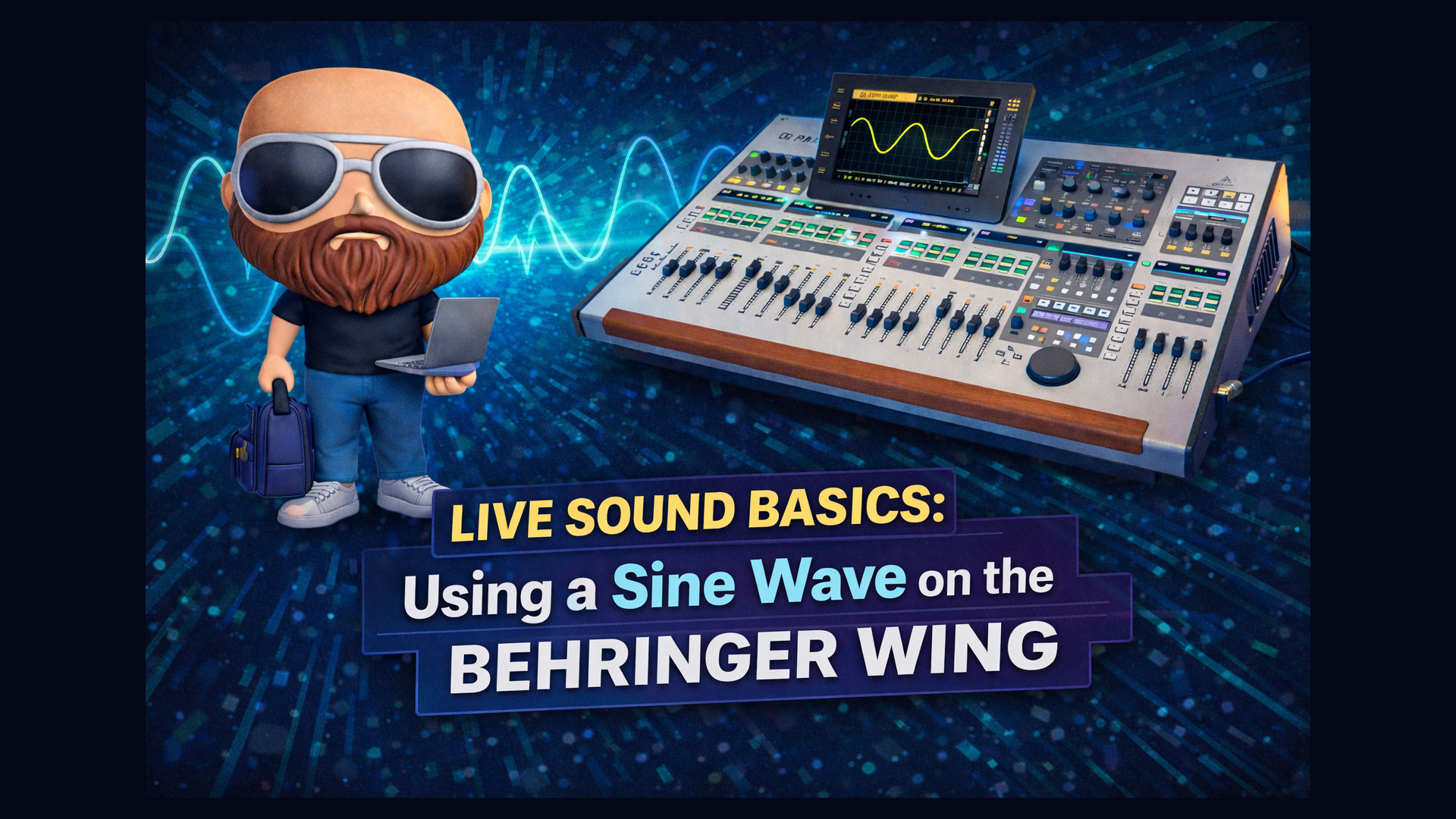
How To Generate and Route a Sine Wave Using the Behringer WING
In the realm of professional audio—especially in environments such as churches where signal integrity and troubleshooting is crucial—understanding how to send a test tone through your mixing console is an essential skill. Whether you’re tracing routing issues, calibrating sound systems, or testing outputs, using an onboard oscillator is a powerful and direct method.
In this tutorial, we’ll guide you step-by-step on how to generate a sine wave using the Behringer WING digital audio console. This process walks you through setting up an oscillator tone and patching it to a channel of your choice.
Let’s dive in.
Why Use a Sine Wave?
A sine wave is a pure, single-frequency tone that allows you to:
- Verify signal flow through a channel
- Test speakers and room acoustics
- Calibrate equalizers, crossovers, and amplifiers
- Identify distortion, harmonics or interference
The Behringer WING includes internal oscillators that can generate sine waves, pink noise, and white noise for system testing. You can route these as sources just like any microphone input or playback track.
Step-by-Step Guide to Setting Up a Sine Wave on the Behringer WING
Step 1: Access the Oscillator Settings
- On the WING touchscreen interface, press the Routing button.
- At the top of the screen, locate the Sources tab and tap to select it.
- If the screen defaults to something like “Local In,” use the drop-down menu to change it.
- From the drop-down, select Oscillator.
- This brings you to the internal tone-generator settings.
Step 2: Choose the Oscillator Type and Frequency
At this point, you’ll see several options at the bottom right of the screen.
Under Type, choose Sine Wave (you’ll also see options for Pink Noise and White Noise).
Set your Frequency:
- Tap the Frequency field to highlight it.
- Use the rotary encoder (the big knob) to dial in a frequency. For example, set it to 600 Hz — a common test tone frequency that works well in midrange speakers.
- You can be precise here—rotate slowly to fine-tune.
Optionally, adjust the Level of the tone if you want to control the amplitude before routing it.
Step 3: Route the Oscillator to an Open Channel
Now that the oscillator is configured, it needs to be routed to a mixer channel for output.
- Find an unused input channel. In the example, Aux 2 (A2) was available.
- On the touchscreen, press the Home button to return to the main channel control interface.
- Select the unused channel you want the tone to go to (e.g., A2).
- On the selected channel’s screen, tap the Patch or Source field to choose the input source.
- Switch the source drop-down to Oscillator and select the oscillator you were working on (e.g., Oscillator 2).
- You’ll now see that the chosen channel is receiving the sine wave signal.
🔊 At this point, you can unmute the channel and slowly raise the fader to hear the tone through the speakers or monitors.
You should hear a clear 600 Hz sine tone.
Modifying the Tone in Real-Time
One powerful feature with the Behringer WING is dynamic tone adjustment while the oscillator is active and routed.
Here’s how to change the frequency on the fly:
- Go back to Routing > Sources > Oscillator.
- Make sure you’re on the correct Oscillator (e.g., Oscillator 2).
- Highlight the Frequency field.
- Use the rotary knob to change the frequency.
- Lowering the frequency down to 400 Hz will produce a lower-pitched tone.
- Increasing to 2 kHz (2000 Hz) will result in a higher-pitched tone.
You can listen in real-time to hear how the tone varies across the frequency spectrum, which is helpful when locating crossover points, dead zones, or distortion in your system.
Applications in the Church Environment
In a worship production environment, the ability to quickly send a test frequency is especially useful during:
- Pre-service sound checks
- Diagnosing signal dropouts in long cable runs or digital stageboxes
- Tuning speaker systems for a specific room response
- Testing the Dante audio network signal flow when routing between devices
Combined with tools like Waves plug-ins and Adobe Audition for frequency analysis, this method gives engineers better control over every stage of the signal chain.
Troubleshooting Tips
- If you don’t hear anything:
- Make sure the assigned channel is not muted.
- Ensure the correct output bus or speaker send is turned up.
- Confirm your oscillator is not set at zero level.
- For safety, always raise the fader slowly when generating tones—especially if speakers are live.
Final Thoughts
Learning to use the oscillator on the Behringer WING unlocks a valuable troubleshooting and calibration tool. Within minutes, you can dial in test tones, route them through any channel, and get immediate feedback on your system’s response. Whether you’re preparing for Sunday service or diagnosing a technical gremlin midweek, this trick belongs in every FOH engineer’s toolbox.